Like many of you lately, AI has been on my mind a lot. I’ve experienced an insane productivity boost at work and have started to think deeper about how to have a well-rounded career that is not just dominated by hitting KPIs at my firm. The other day, I was brainstorming on which parts of my career (and life frankly) I should upskill and the one I come back to is negotiation.
If you’re in tech (or tech adjacent), one of the first things that comes to mind when you think of this is Patrick McKenzie’s excellent advice the topic. Re-reading it re-affirmed my belief that the thesis is still sound. I think what I love most about this blog post is how accessible it is. It is very information dense but doesn’t make you feel like it. I have some qualms with how some parts of the post are presented e.g. the conversation between recruiter/hiring manager and you (the negotiator) because there is no clear indication of who’s speaking, and it isn’t strictly a back-and-forth exchange (i.e. sometimes one person speaks twice in a row).
Anyway, when I first read this a couple years back (before starting my blog), I compiled some notes from the blog post. I am constantly gradually intersplicing some more notes from my own experience as I build a better model of this topic.
Notes
Negotiation is not haggling. In fact, rich, successful people negotiate. This is how they get (and stay) rich. You’ll find reels like these on how F500 execs negotiate some insane perks into their contracts such as mansion renovations, pet relocation and even jobs for their spouses.
All this is to say that companies are not sensitive to small differences in employee wages. Employees are expensive anyway. They take (paid) time to be trained, they sometimes slow the rest of the team down in the beginning and can be a massive opportunity cost at times.
However, virtually any amount of money available to you personally is mouse droppings to your prospective employer. What the employer does care about though is your expected value i.e. whether will you’re likely to create will outweigh the costs of hiring you. One of the best ways to signal this is to have a track record of demonstrable results and to signal boost them through your preferred channels. As much as I hate LinkedIn, I still think this is its main value proposition.
You will have much better results if your job search looks something more like this:
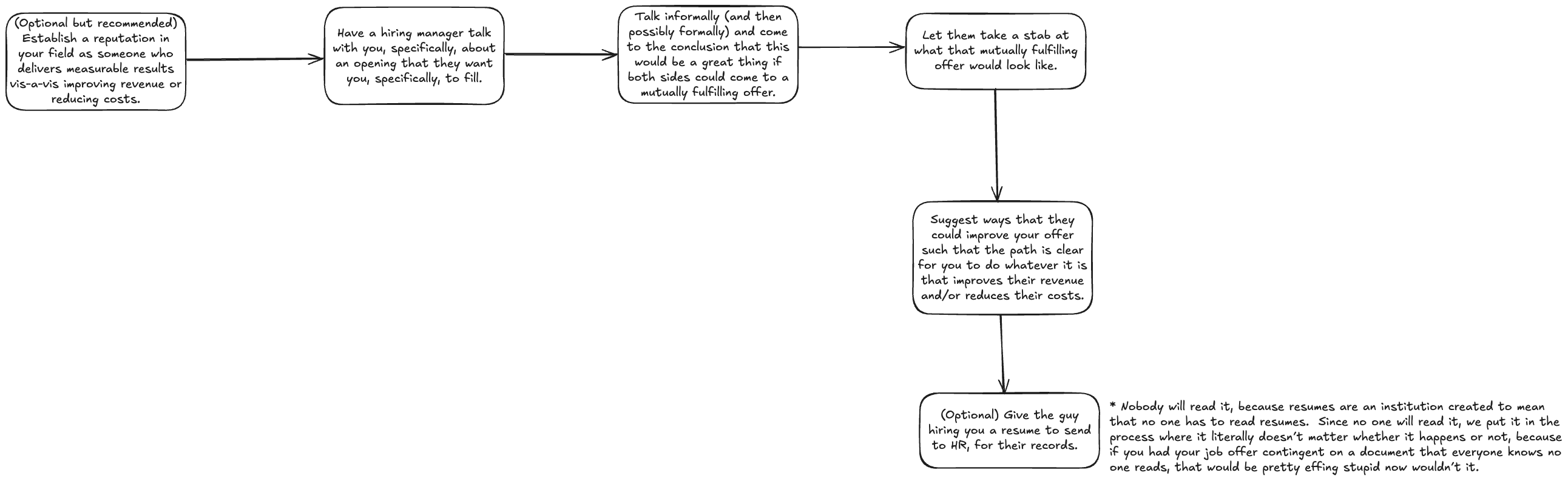
Salary negotiation
- Negotiate over email rather than in real time whenever possible.
- Only negotiate salary after you have agreement in principle from someone with hiring authority that, if a mutually acceptable compensation can be agreed upon, you will be hired.
- Negotiating never makes (worthwhile) offers worse.
- You do not start negotiating until you already have a “Yes-If” i.e. “Yes-If we agree on these terms…”
- The ideal resolution to the job interview is for both sides to be optimistic about the arrangement, and then you close with a warm handshake and “I look forward to receiving your offer by, oh, would tomorrow be enough time for you to run the numbers?”
The conversation between the recruiter (or hiring manager) should look something like this:
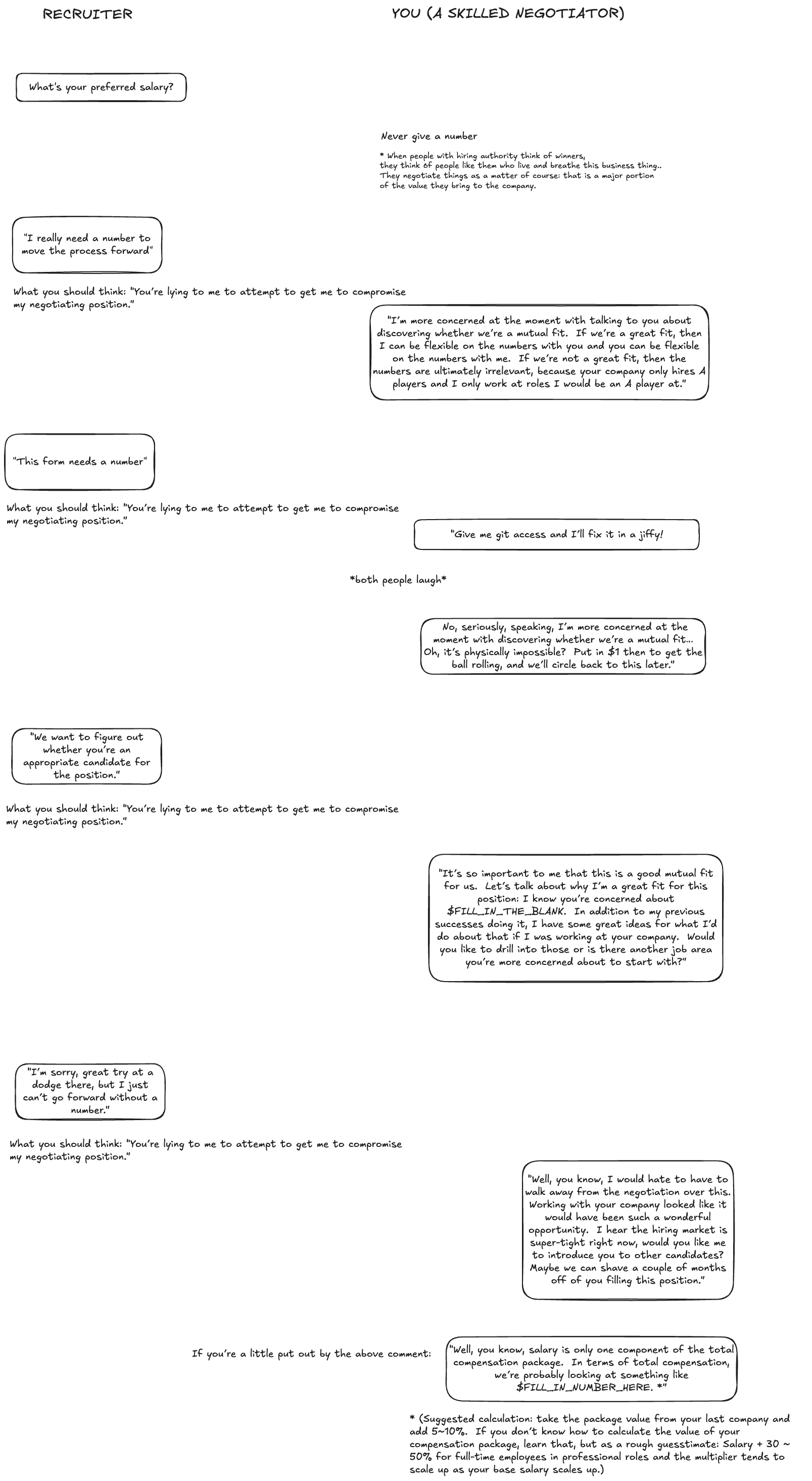
Interviews
Take notes during job interviews
- Taking notes says “I’m attentive and detail-oriented and I care about what you say.”
- Make sure you can take notes without playing with your pen or otherwise appearing to fidget.
Write down the numbers e.g.
- vacation days
- agreed salary
- how long the posting has been up
Get the offer written down by them
Do NOT Volunteer useless information (like how long you’ve been job searching)
Say “we” and variations on “mutual win”
You should:
- talk more about their problems/concerns/wishes
- stop yourself from bringing up irrelevant things like your own problems, which typically will not help you sell the decision-maker on adopting the mutual win you’re proposing

Do your research
Find the salary range for your position Seek out current and ex-employees to figure out the following info:
- What do they value?
- Who do they value within the company? (Roles?, Titles?, Groups?)
- What does the career path look like for successful people within the company?
- Roughly speaking, how generous are they with regard to axes that you care about?
- Do they have any compensation levers which are anomalously easy to operate? For example, if you asked around, you might hear a few people say that a particular firm pushes back modestly on out-of-band increases in salary but they’ll give in-the-money option grants like candy
- All the fuzzy stuff: what’s the corporate culture like?
You can bring some of these questions to the interview
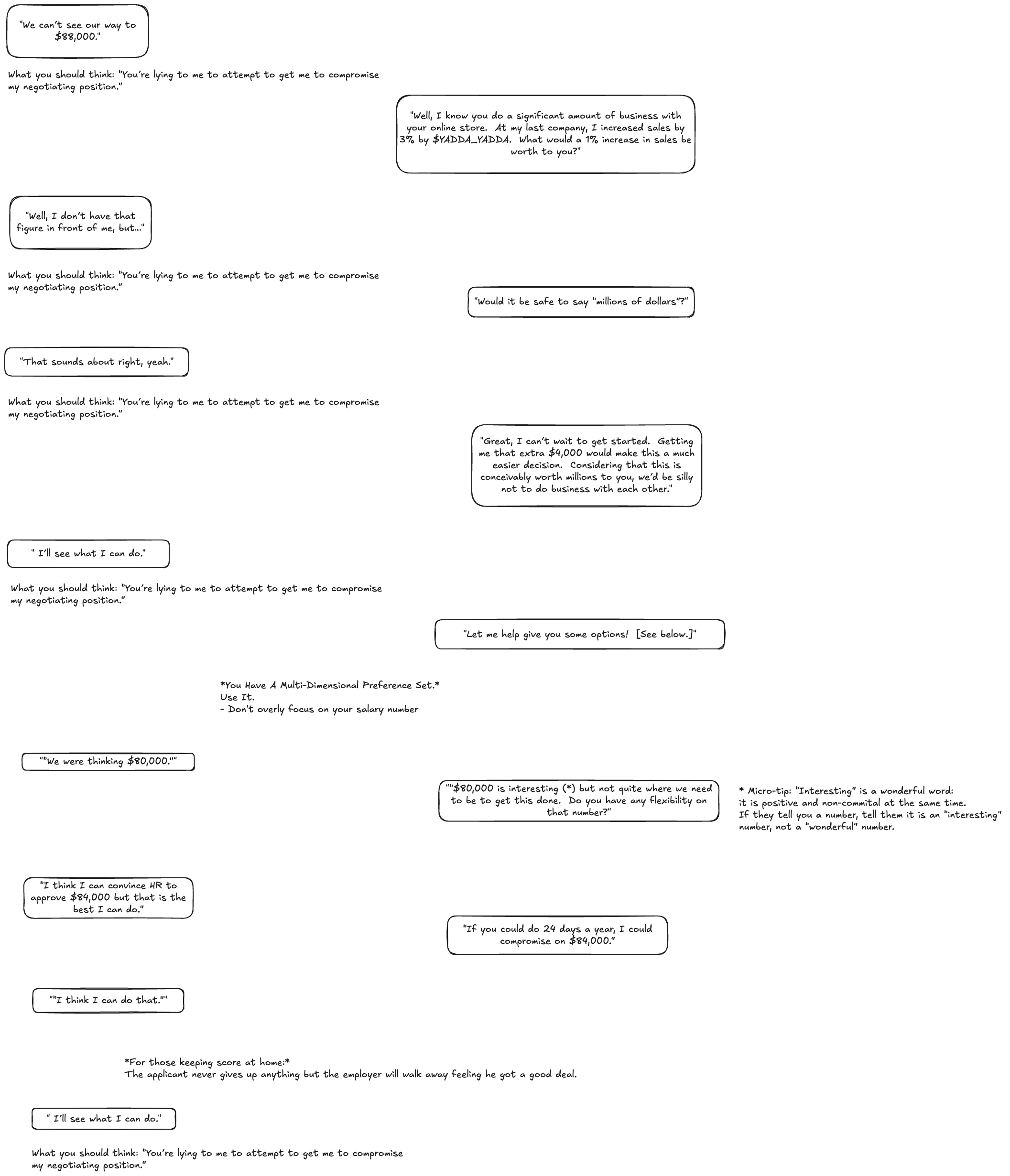
Closing the offer
- Don’t overly fixate on the number. Pull on other levers like vacation days, stock options, insurance benefits and retirement plans.
- Have an $EXTERNAL_AUTHORITY. Patrick puts it best:
Hopping around the offer also helps you defuse common negotiating tactics like “I have to go to $EXTERNAL_AUTHORITY to get approval of that.”
This is in the negotiation playbook, because it works well: it injects an automatic delay in the process, and gives you a scapegoat for refusing a request while not being guilty of the refusal yourself. You should strongly consider having an $EXTERNAL_AUTHORITY of your own.
Significant others work well. Note that in the US your would-be employer is legally prohibited from breathing about the subject of your marital status, so something like “We’ll have to talk that over” or “That sounds reasonable, but I’ll have to run it by the family” has the dual virtues of being a socially acceptable reason to delay any major decision while also being equally available to unattached young’uns. I talk shop with my family all the time. I’ll certainly continue discussing employment with my family after it includes my fiancee, too.